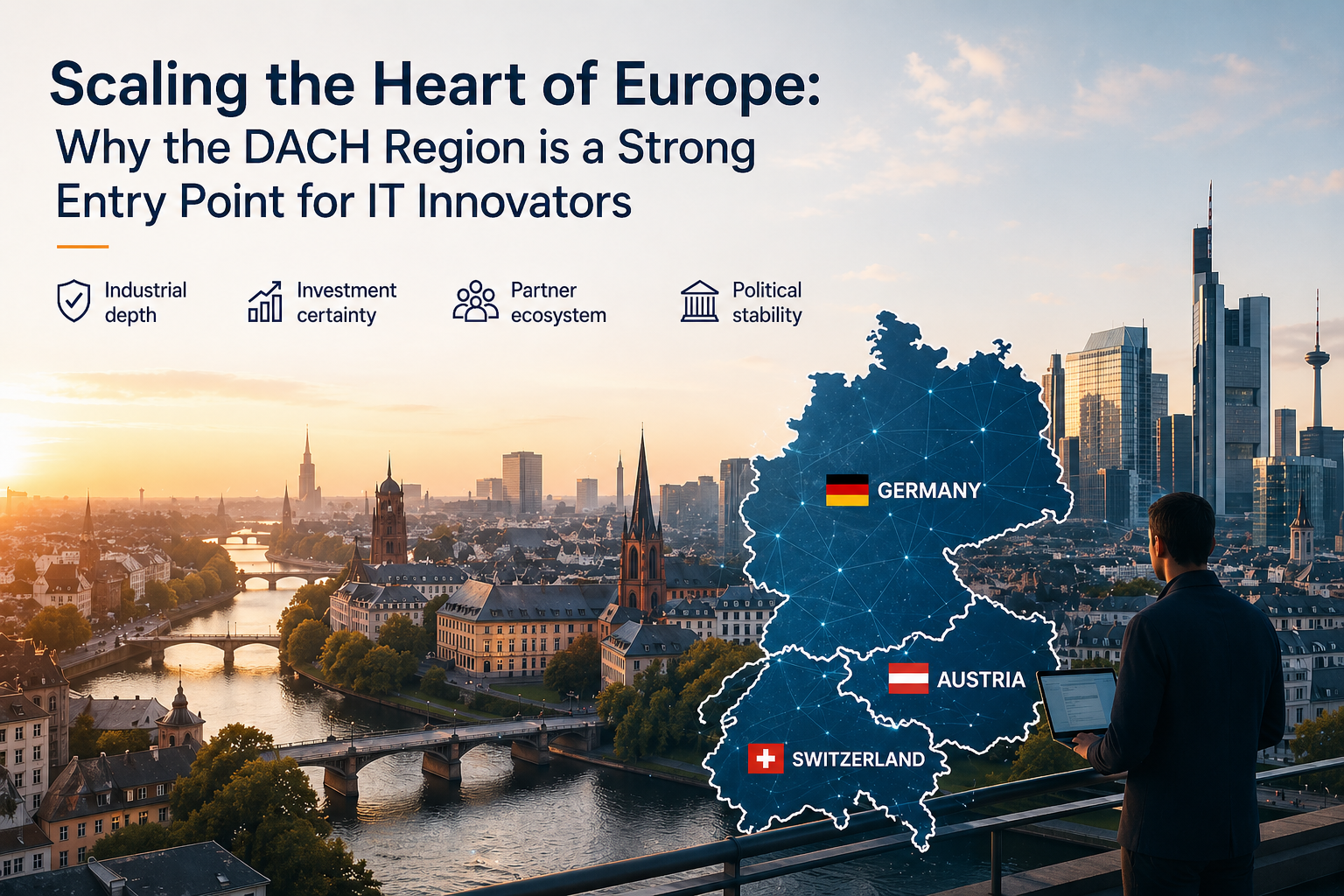
Scaling the Heart of Europe
Why the DACH Region is a Strong Entry Point for IT Innovators
When international IT firms eye European expansion, the magnetic pull of London’s VC scene or Dublin’s tax incentives is undeniable. However, tech leaders have to look past the obvious toward a region offering something far more valuable: industrial depth, investment certainty, political stability, and a partner ecosystem built for long-term dominance.
Welcome to the DACH region (Germany, Austria, Switzerland). The argument for this region isn’t just about size—it’s about a unique economic architecture that transforms IT vendors into essential industrial partners.
1. The Economic Safety Haven: Growth in a Volatile Era
While global markets face 2026 with a degree of uncertainty, the DACH region has leaned into its strengths.
- Resilient Growth: Germany’s GDP is rebounding at 0.9%, while Austria leads the pack at 1.2%, consistently outperforming the EU average. Switzerland, a non-EU country maintains a steady growth trajectory of 1.0% in 2026. Despite a strong Franc, its focus on high-value exports and financial stability makes it a safe haven for capital-intensive startups.
- The R&D Powerhouse: Innovation here isn’t just a buzzword; it’s a line item. Austria currently ranks 3rd in the EU for R&D intensity with 3.34% of GDP, and Germany follows at 3.13%. Switzerland’s 3.3% rate as well significantly outpaces the EU’s average of 2.24%.
- Fiscal Incentives: Unlike the equity-heavy models of the US or UK, DACH offers significant “non-dilutive” support. In Austria, e.g. companies can claim a 14% uncapped cash refund on R&D expenditures, regardless of whether they are yet profitable.
2. The Structural Reality: Why “Indirect” is the Way
The defining feature of the DACH market is its fragmentation. Approximately 99% of companies in Germany are SMEs (the Mittelstand), offering a huge opportunity in terms of economic diversity and verticals. These firms account for over 53% of employment in Germany and the vast majority of GDP across the entire region.
Depending on ist Ideal Customer Profile (ICP) this presents for a young IT company a unique opportunity: a highly diversified customer base with regional specializations and a relationship-driven buying culture to be leveraged.
Strategic Insight: This is why in DACH, direct enterprise sales alone do not scale. To win, you must orchestrate a partner-led Go-To-Market (GTM) strategy.
3. Mapping the Ecosystem: Your Five Pillars of Access
Success in 2026 requires moving away from “linear” sales toward an ecosystem-led approach or a mixture of both, as some oft he succesfull market entrants prove. According to recent data, your GTM strategy should be built upon these five pillars:
A. The Value-Added Resellers (VARs) & System Houses
VARs are the backbone of SME access. Because DACH SMEs prefer local, long-term partners, these system houses hold deep customer trust. They don’t just sell software; they implement and support it, making them the primary channel for scaling into the „Mittelstand“.
B. Managed Service Providers (MSPs)
As IT complexity increases and the skills shortage in DACH persists like elswhere in Europe, more companies are outsourcing their operations. MSPs provide subscription-based, long-term revenue and are the ideal partners for “land-and-expand” strategies.
C. System Integrators (SIs)
For high-ticket, mission-critical solutions—think AI deployment or complex cloud migrations—SIs are non-negotiable. They dominate the Upper Mid-Market and Large Enterprise segments.
D. The Influence Layer: Consulting Firms
Strategic consultants (both global giants and regional boutiques) serve as the “control point” in enterprise deals. They influence buying decisions early by defining the architecture and selecting the vendors.
E. Tier-2 Enablers: Distributors
Distributors provide the logistics and financing needed to enable thousands of small resellers simultaneously and provide access to this channel.Depending on your product and ICP, they can be a good entry point into the region.
4. Market Segmentation: Targeting the “Hidden Champions”
Winning in DACH requires a tailored approach for different company sizes:
| Segment | Characteristics | Buying Model |
|---|---|---|
| SME / Mittelstand | Owner-led, conservative, long-term oriented. | Trust-based; driven by local VARs and MSPs. |
| Upper Mid-Market | Global niche leaders (“Hidden Champions”) with highly digitized production. | Demand for AI, IoT, and industrial software via SIs. |
| Large Enterprise | Global procurement, complex landscapes. | Dominated by SIs and consulting firms, often through framework agreements. |
5. The Vertical Playbook: Where the Money is
Horizontal “catch-all” GTM strategies risk to underperform in this region. Instead, Go Europe Consulting recommends a vertical-first entry:
- Germany (The Industrial Backbone): Focus on manufacturing, automotive, and chemicals. These SMEs are often Tier-1 suppliers requiring advanced Industrial AI and supply chain software.
- Austria (The CEE Bridge): Beyond its own manufacturing and logistics sectors, Austria serves as a regional HQ hub for companies looking to expand into Central and Eastern Europe.
- Switzerland (High-Value Sectors): Demand is concentrated in Pharma, Life Sciences, and Financial Services. These sectors require compliance-heavy IT and top-tier security solutions.
6. Why DACH Beats the Rest
What makes DACH a better entry point?
- Industrial Integration: Your software becomes part of a physical product (cars, machines, medicine), leading to much lower churn than pure “office tech.”
- Regulatory Gold Standard: If you can pass the rigorous data privacy and compliance standards of Germany, Austria and Switzerland (like the revDPA), you can sell anywhere in the world with instant “trust-credibility.”
- Capital Concentration: While VC funding elsewhere can be “noisy,” the DACH region focuses on Deep Tech. In 2025, German startups alone secured over €8 billion, with a heavy lean toward industrial application. Clearly, industrial tech is outperforming consumer software in the region, providing another proof-point of a strong B2B market.
The Bottom Line for Your Business
The DACH region is not just a market; it is a highly specialized ecosystem. Success here isn’t about how many cold calls you make—it’s about how effectively you orchestrate a multi-layer partner network. For Go Europe Consulting, the path is clear: Build trust locally, specialize vertically, and leverage the partner engine.
Source: GOEUROPE CONSULTING, by Dr Jürgen Müller.